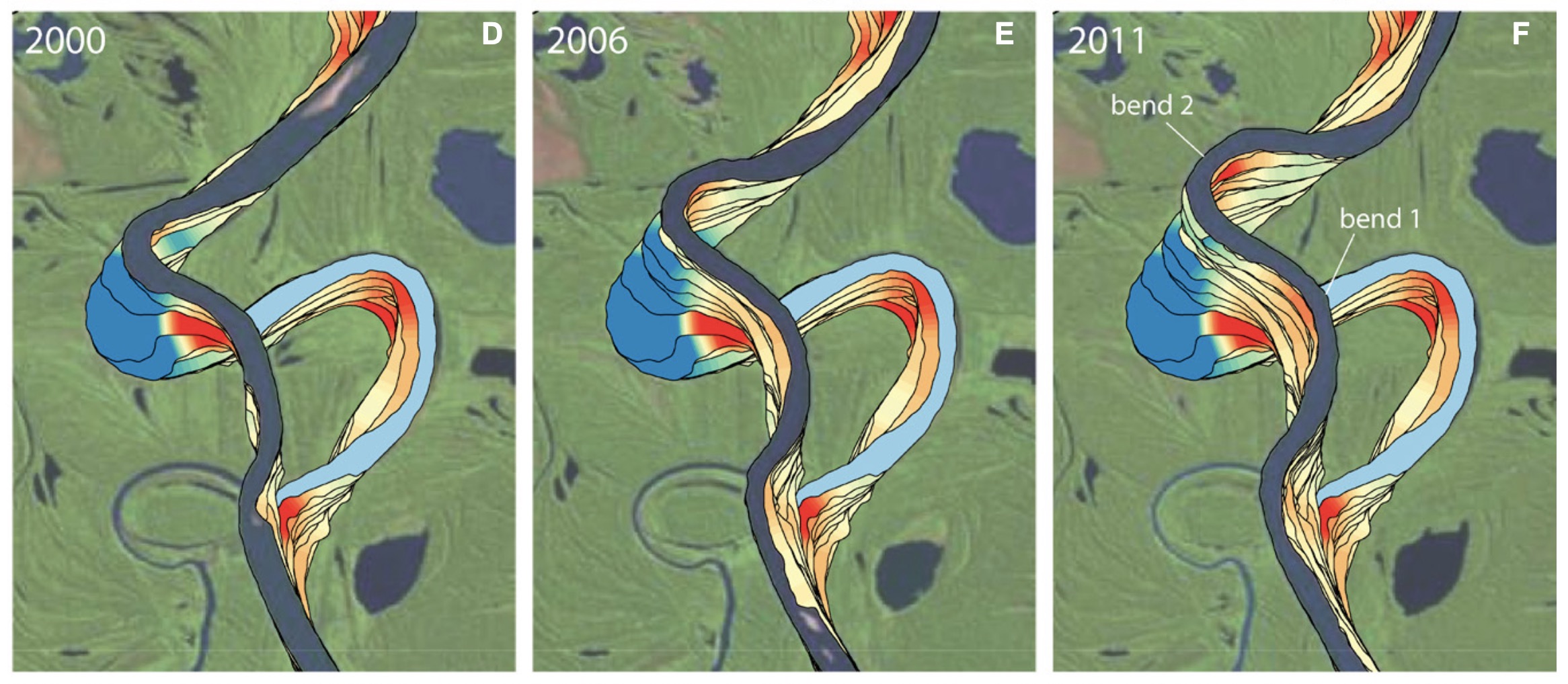
Autogenic translation and counter point bar deposition in meandering rivers
This paper explores the development of counter point bars in meandering rivers through autogenic translation processes.
This paper explores the development of counter point bars in meandering rivers through autogenic translation processes.
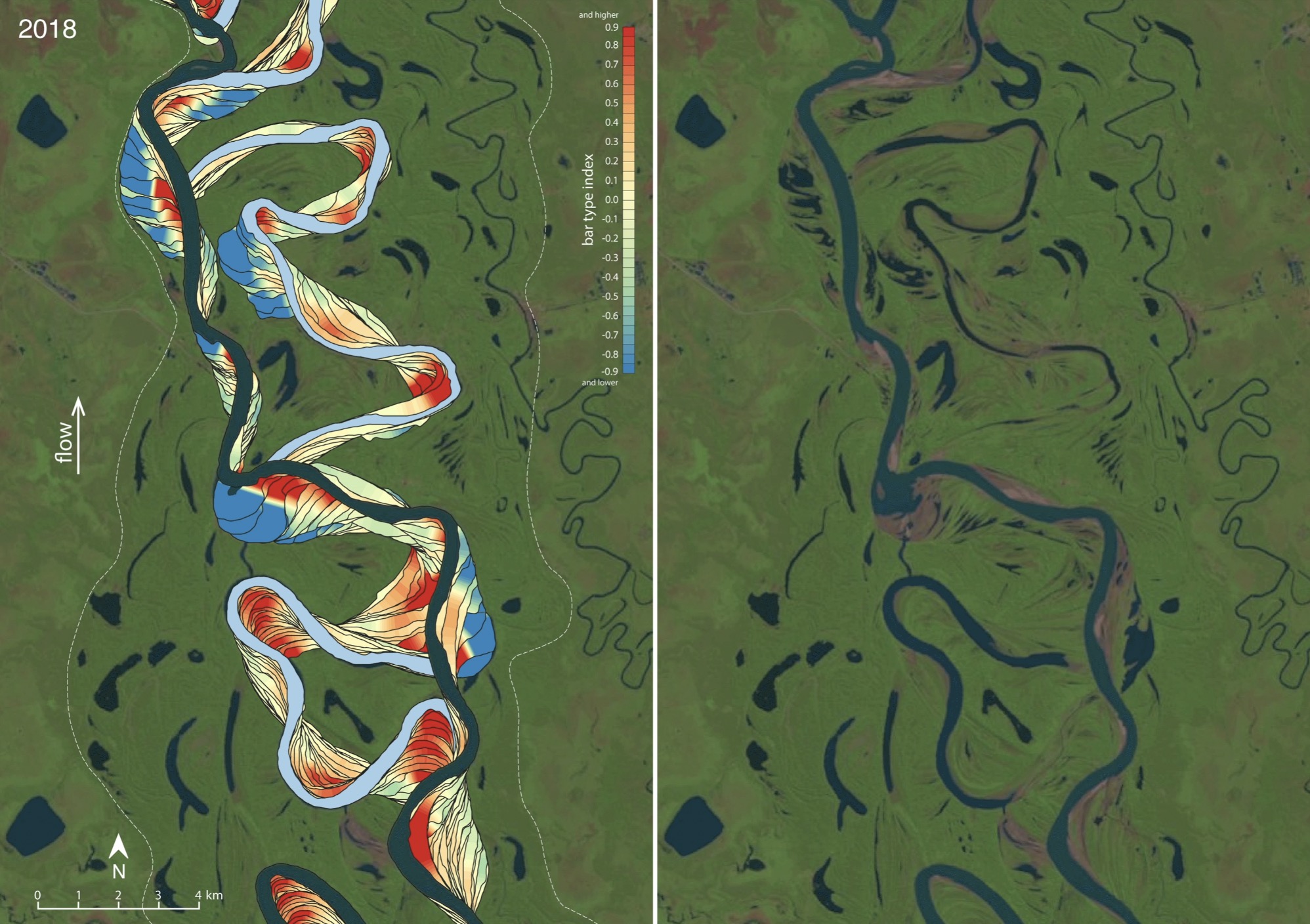
The simplest definition of point bars is that they are sedimentary deposits forming on the inner, convex bank of river bends. [‘Inner’ and ‘convex’ bank means that, looking toward the river, the bank is curving around you.] Amadeus W. Grabau, an early ‘influencer’ in stratigraphy and sedimentary geology, published a beautiful drawing of how meanders grow, point bars evolve, and oxbow lakes form, more than a hundred years ago: Diagram illustrating the development of meanders in a river. From Grabau (1920). ...
River meander migration plays a key role in the unsteady ‘conveyor belt’ of sediment redistribution from source to sink areas. The ubiquity of river meandering is evident from remotely sensed imagery,…
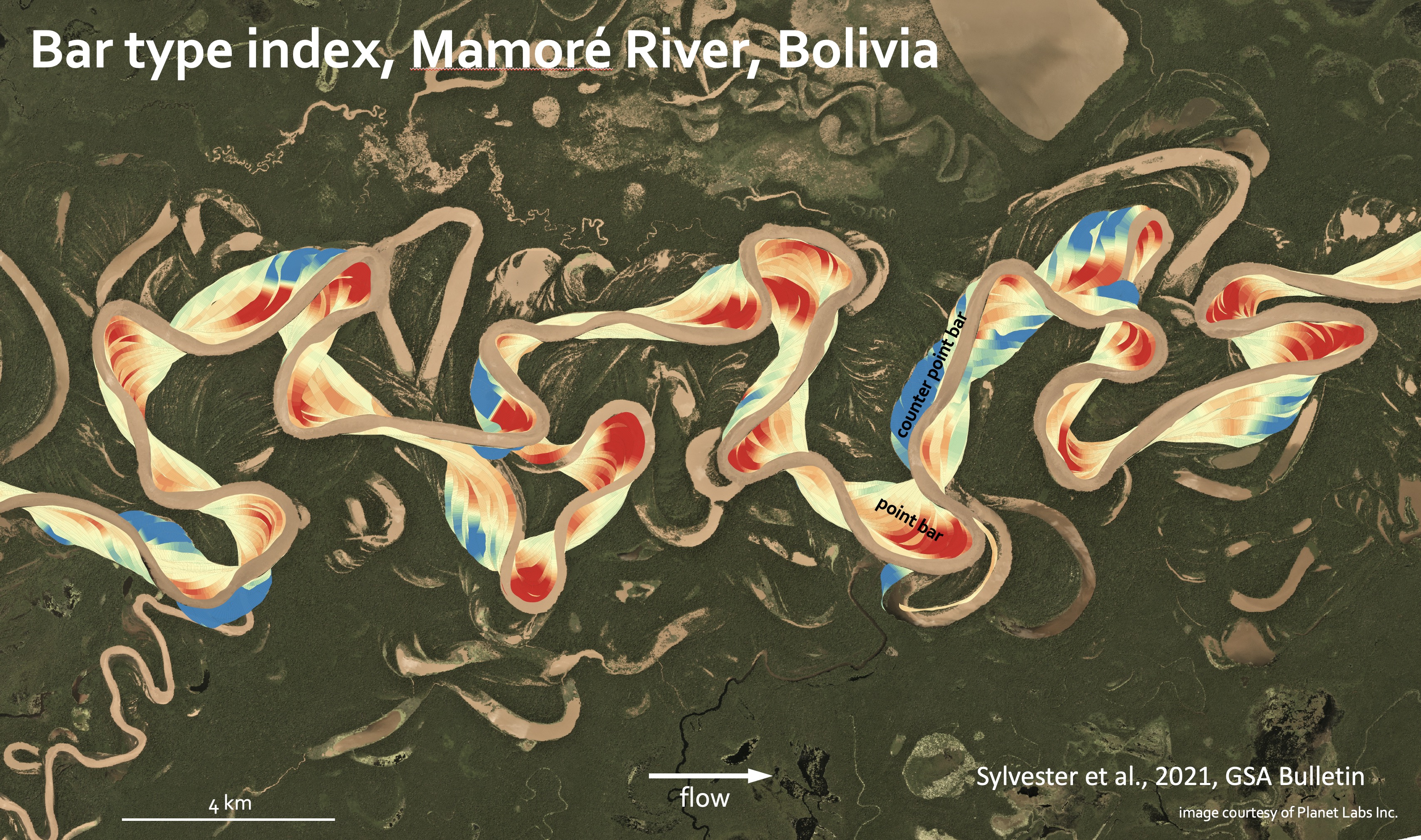
This presentation explores the dynamics of meandering systems in both fluvial and submarine environments, focusing on the predictability of channel migration and the resulting stratigraphic heterogeneities.
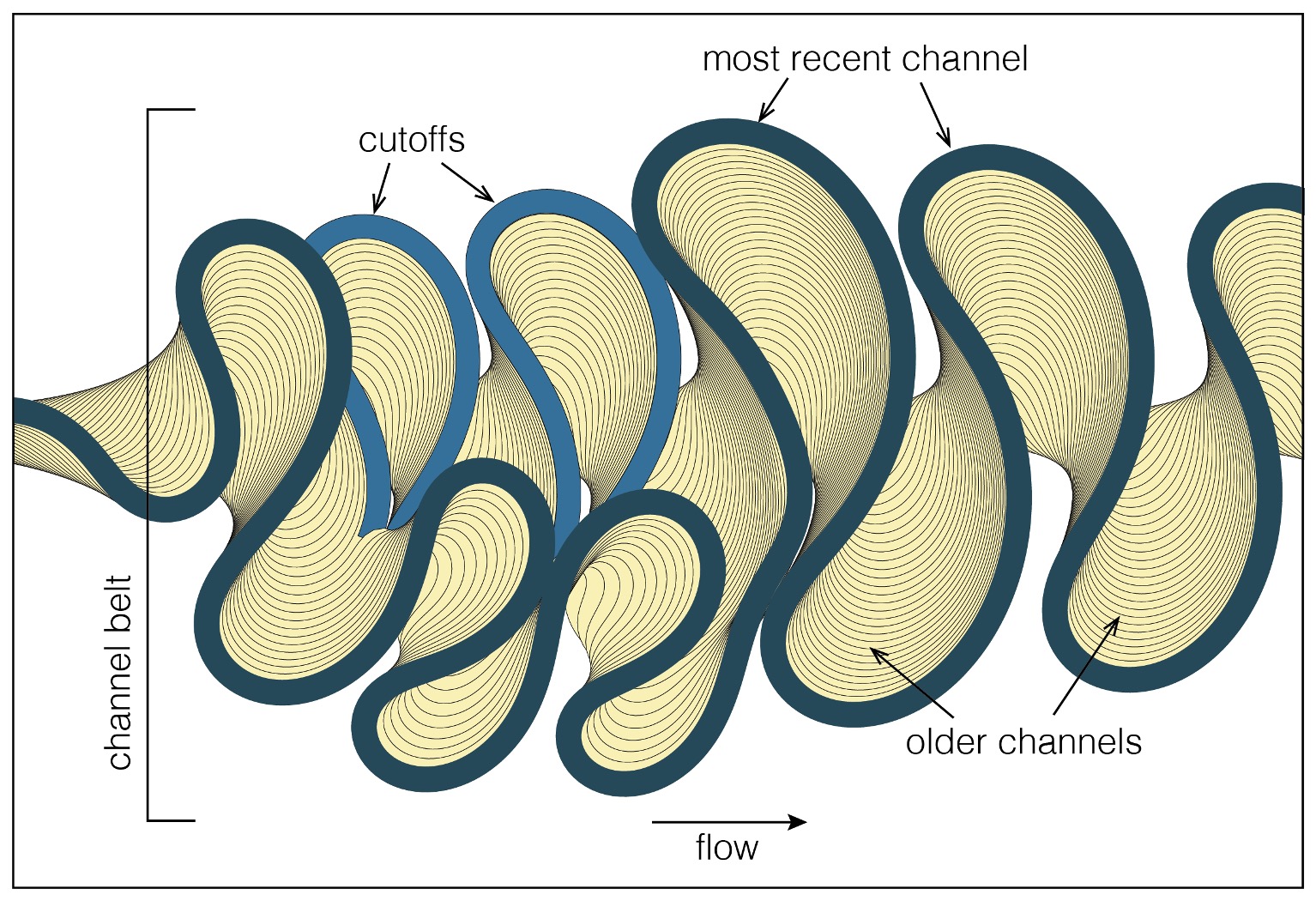
‘meanderpy’ is a Python implementation of a simple kinematic model of meandering, based on the Howard and Knutson (1984) model.
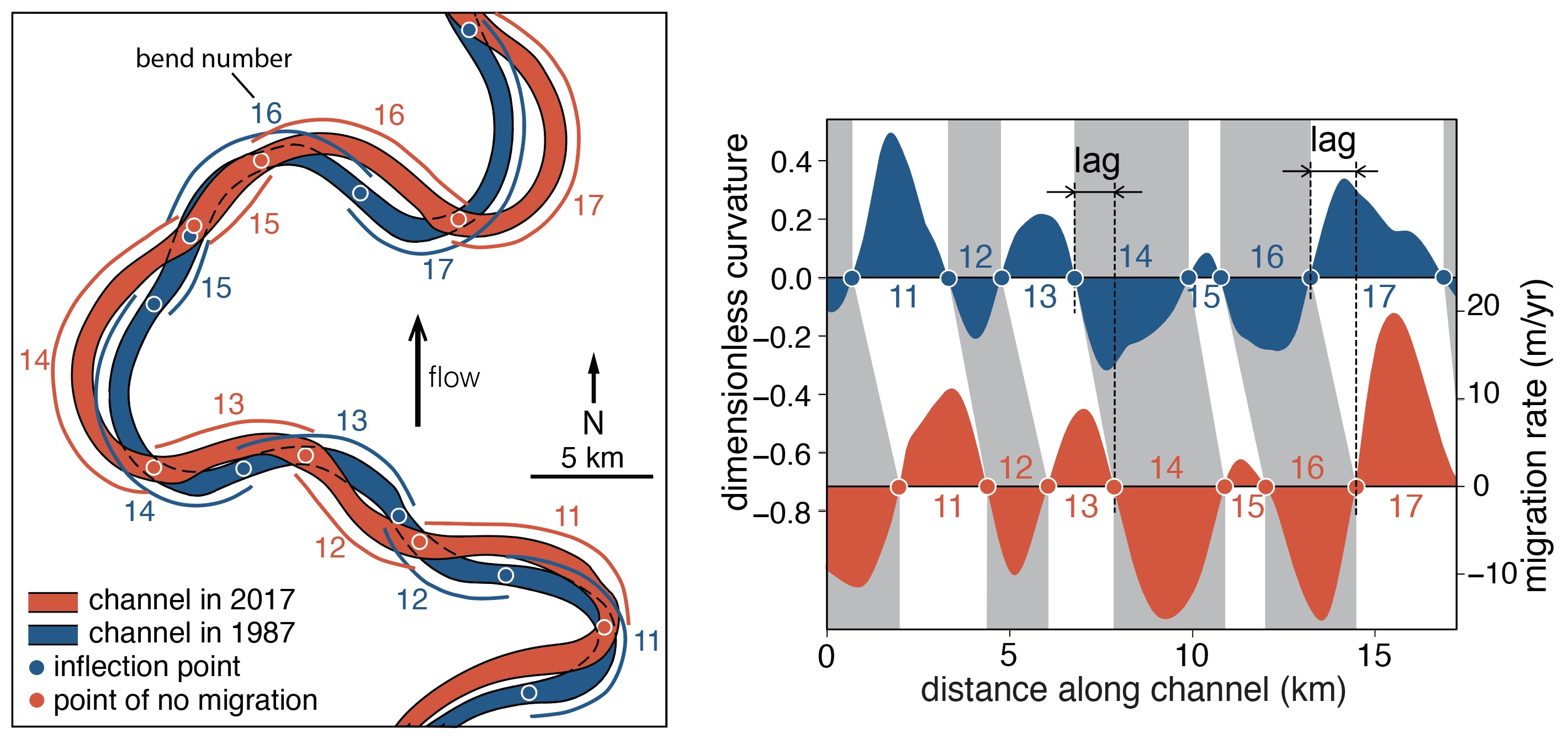
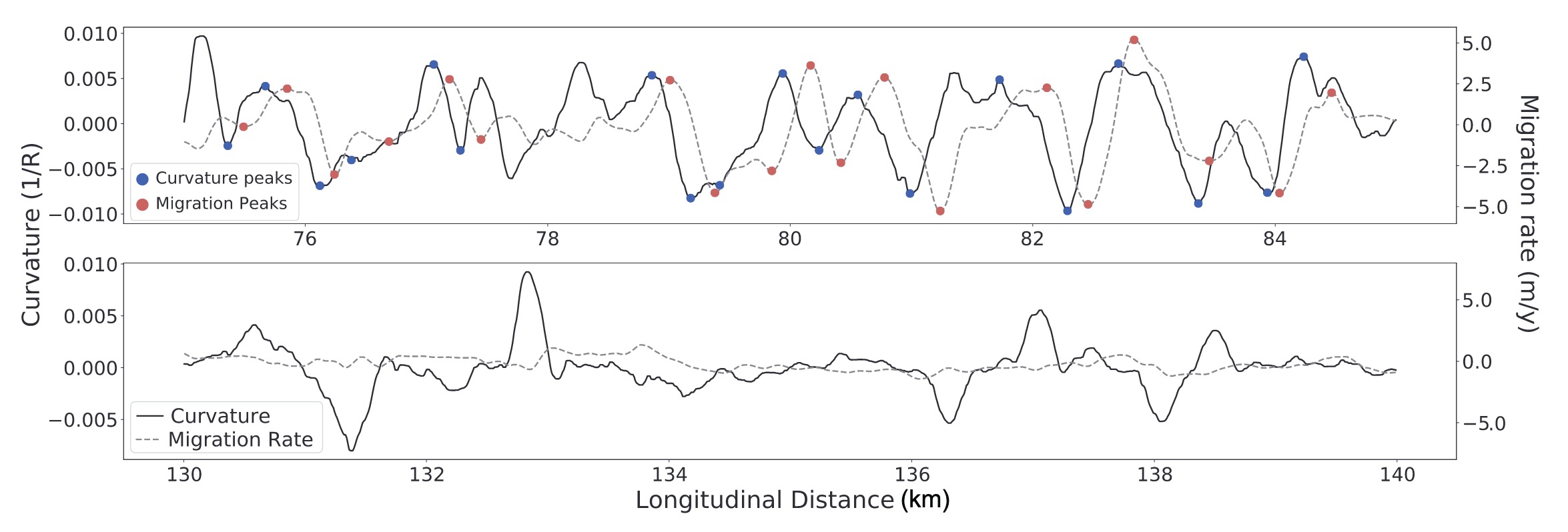
The answer, at least for seven rivers of the Amazon Basin, seems to be negative, as we try to demonstrate in a paper that was recently published in Geology. My coauthors are Paul Durkin, at the University of Manitoba, and Jake Covault, at the Bureau of Economic Geology, The University of Texas at Austin. In this blog post, I try to provide a bit more background to our paper. Why is this an interesting result? After all, it makes sense that there is more outer bank erosion in sharper bends. Erosion is primarily a function of the shear stress exerted on the bank; and shear stress is high where the high-velocity core of the river gets close to the bank (because in this case flow velocity has to quickly decrease from a maximum to zero, and shear stress is a function of the rate of change in velocity). The high-velocity core gets pushed close to the bank if the centrifugal force is large; and the centrifugal force is directly proportional to curvature, 1/R (where R is the radius of curvature). In short, if we use the simplest, most pedestrian physical reasoning, we would expect that erosion, and therefore bank migration, are high in high-curvature bends. However, a lot of previous work on meandering rivers suggests that this is not the case. ...